


Horse lame – Vet diagnosis: no signs of laminitis, but since the horse is lame and slightly overweight, it has to be laminitis.
This just happened to a client, and you can imagine how freaked-out the owner was. Unfortunately, it is not a single occurrence to get a laminitis diagnosis, when there is no laminitis.
The horse transitions well to barefoot trimming, is moving freer, muscle tension is going away, stance, loading, and movement patterns are improving. Suddenly, the horse presents with some temporary, often sudden, lameness. Emotions run high, the stressed client calls in a vet for lameness diagnostics. The vet assesses the hoof of concern as it presents, typically without further investigating how the hoof may have changed over the last few months, or how the whole horse has changed over the same period, aka hoof history.
X-rays get taken. No signs of laminitis. Sole thickness good. Bone alignment good. No response to hoof testers. Pulse, not reported on. Conclusion: it must be some low-grade laminitis since the horse is lame and slightly overweight. Restrict High Carb feeds and administer Bute.
Did the hooves show Hoof Mechanism (HM) on loading? Not checked.
A horse with laminitis is typically highly sensitive to hoof rasping. Well, this one wasn’t. No strong or elevated pulse. Happy to lift the hooves for trimming. But overall the hooves were too long and had full bars, due to being ridden less for the previous month, ground being softer, and left and extra week between trims. HM reduced to non-existent. Trim the hooves, get HM established, check for good loading pattern. Within a week the horse is fine again.
Learning to see how your horse loads its hooves and whether or not they have HM is so important. Many problems can be eliminated/prevented by just managing this.
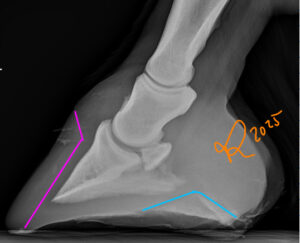
The photo below shows how the inner hoofwall run parallel to the dorsal aspect of P3 (pink line). The blue contour shows the (still) deep Collateral Groove, which can easily lock up when the bar gets too long. The focus needs to be to further relax that region.
Other examples include where horses are lame and have a strong pulse. Diagnosis: Laminitis. Despite the horse standing on the hoof’s toe and unloading the heels. A few days later, a heel abscess opened up.
Don’t be afraid to get another opinion, when your horse gets a laminitis diagnosis.