Hoof Hydration Reminder

Just as Canterbury is drying out due to a series of North-West winds, a couple of clients sent me these photos of their newly built hoof-bath solutions.
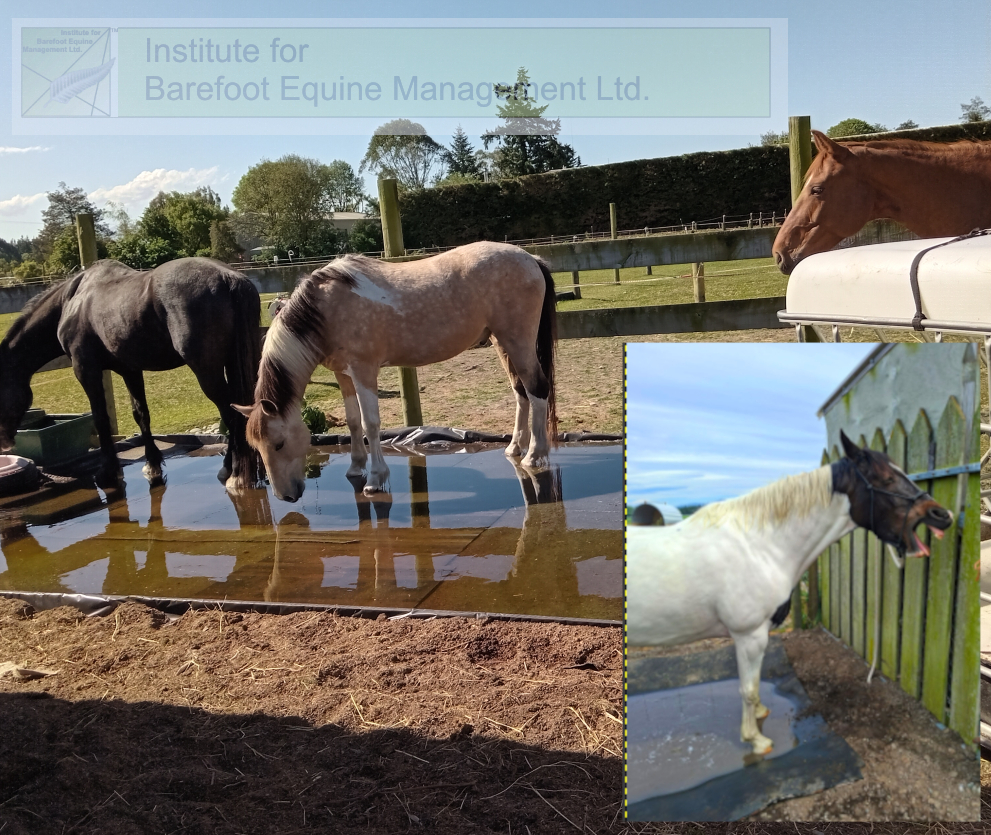
What’s the point of this, you might say?

For hooves to stay functioning and healthy, certain parameters must be met.

  1. the hoof-capsule must be maintained in a shape/proportions so it can expand on weight bearing
  2. the ground needs to be sufficiently firm to facilitate such expansion (especially in winter)
  3. the hooves need to be sufficiently hydrated to allow such expansion (especially in dry conditions)
  4. the horse needs to move. Just standing around in a yard or around a hay feeder leads to insufficient steps and therefore hoof expansion.

Not having enough hoof hydration over summer affects the horse in the following way:

  1. the hoof becomes stiff and less flexible to expand properly
  2. less hoof function allows more build up of bars and sole
  3. more build up of bar affects the way the horse loads the hoof – typically toe-heavy
  4. this affects the regrowth pattern and stance – heels tend to grow too fast, increasing PA
  5. chronic overload of toe lamellae and under-stimulation of lamellae towards the back. toe coronet overloaded
  6. the trimmer cannot correct the situation properly has hooves are too hard to cut

If your horse is allowed to go through summer with this pattern, be prepared that it becomes sore once the hooves regain their ability to expand again. Typically that occurs when the rain sets in, in autumn – aka re-hydration. The return of hoof expansion and better blood flow to the compromised internal tissues, will lead to a patho-physiological response – inflammation. We will observe this as a tender-footed horse, probably with and elevated and strong digital pulse.

And of course, the grass starts growing again at the same time, and now it’s the grass’ fault.

Ground Considerations

By Thorsten Kaiser

When this article was written, it was winter in New Zealand. For most part of the country that means wet and muddy fields where we keep our stock, including horses. But the issue is also present if the horses are kept on other soft substrates (loose sand, bark, saw dust, deep loose gravel, etc) at other times of the year, or worse, all year round.

One thing to remind ourselves is how the equine hoof functions. For the hoof to function, apart from the correct shape that allows this, it needs a certain firmness of the ground to provide enough resistance to expand the hoof capsule and create hoof mechanism. This hoof mechanism will allow for optimal blood flow to the soft tissue inside that is responsible to grow the right amount of horn. The soft ground now reduces this action and as a result reduces horn production and horn quality. We often hear the phrase the hoof grows less in winter.

If the horn quality of the external horn deteriorates, that is kind of obvious – brittle horn, weak frogs and pitted sole. Usually “the wet” gets the blame. However, if the internal horn, the laminar line horn that bonds the pedal bone to the hoof wall, is compromised, then this is not immediately visible. We will see the signs of that weakened bond when the ground hardens out again in spring and the foot gets stimulated more, then, out of a sudden, there is a sore horse. Often the diagnosis then is laminitis.

This does not need to be the case, if the horse has a functioning hoof and is offered firm enough ground so that it needs to spend some time on it to walk about. In reality terms that means the horse shelter and the adjacent areas should be prepared so it does not become a bog. A driveway can work well, too. We then can offer hay in those areas and make the horse spend some time on it. Providing a firm-enough ground now, will safe us (well, and the horse) trouble later on.