We have just added this new section to the website. You can get to it via this link.
Simply go there, create an account if you haven’t got one, then click “Take the course”, and you are in.
It contains videos and articles on hoofcare related topics. The first few posts are establishing the basics in hoof anatomy, which is the foundation for anyone who would like to understand hooves, or even work on them.
It is supported via a chat group. You will find the links to that in the course description.
Feel free to make suggestions on what topics you would like to see covered, as well as how you like the format.
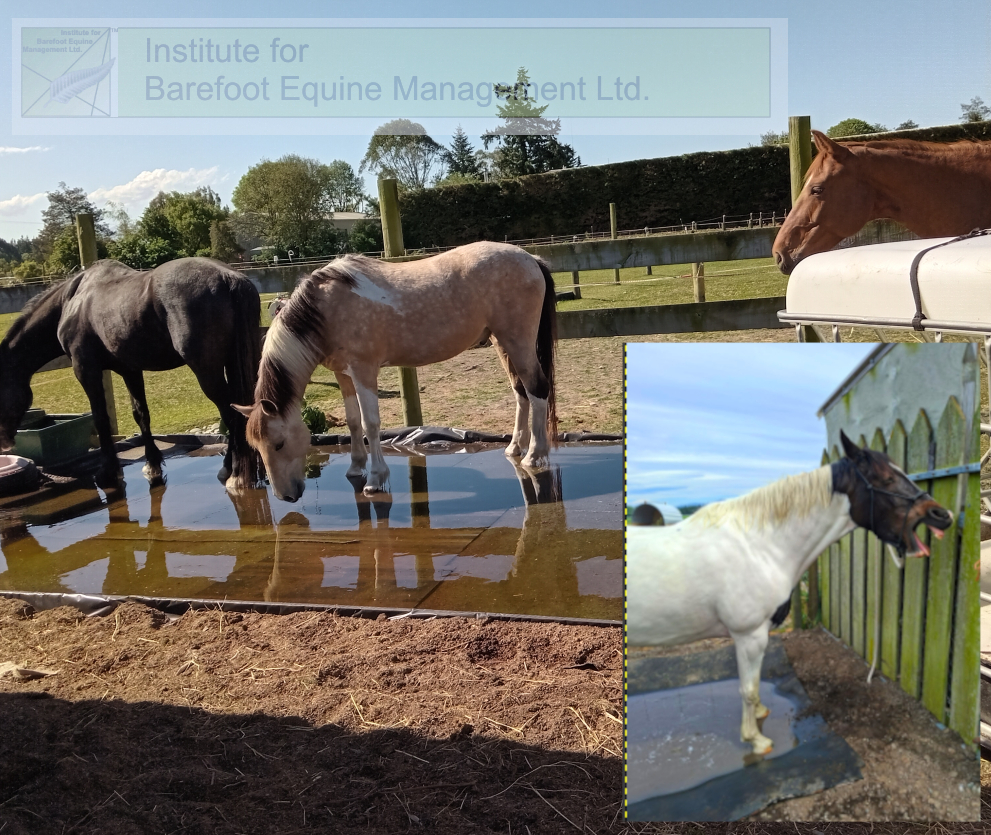
Just as Canterbury is drying out due to a series of North-West winds, a couple of clients sent me these photos of their newly built hoof-bath solutions.
What’s the point of this, you might say?
For hooves to stay functioning and healthy, certain parameters must be met.
the hoof-capsule must be maintained in a shape/proportions so it can expand on weight bearing
the ground needs to be sufficiently firm to facilitate such expansion (especially in winter)
the hooves need to be sufficiently hydrated to allow such expansion (especially in dry conditions)
the horse needs to move. Just standing around in a yard or around a hay feeder leads to insufficient steps and therefore hoof expansion.
Not having enough hoof hydration over summer affects the horse in the following way:
the hoof becomes stiff and less flexible to expand properly
less hoof function allows more build up of bars and sole
more build up of bar affects the way the horse loads the hoof – typically toe-heavy
this affects the regrowth pattern and stance – heels tend to grow too fast, increasing PA
chronic overload of toe lamellae and under-stimulation of lamellae towards the back. toe coronet overloaded
the trimmer cannot correct the situation properly has hooves are too hard to cut
If your horse is allowed to go through summer with this pattern, be prepared that it becomes sore once the hooves regain their ability to expand again. Typically that occurs when the rain sets in, in autumn – aka re-hydration. The return of hoof expansion and better blood flow to the compromised internal tissues, will lead to a patho-physiological response – inflammation. We will observe this as a tender-footed horse, probably with and elevated and strong digital pulse.
And of course, the grass starts growing again at the same time, and now it’s the grass’ fault.
When it comes to talking about causes and treatment of Laminitis, there are many opinions “out” there, and sometimes it appears they contradict each other. How can this be? Does that mean only some views are correct, and consequently the others must be incorrect?
Based on my experience over the last two decades, I have concluded that the confusion and different opinions we read are the result of mixing up different event mechanisms that lead to a situation we call laminitis. In other words, we are not talking about the same “thing”.
The common denominator is the word Laminitis and on the first glance they look similar on x-rays. While acute, the horse presents the same way, aka fronts camped out, hinds standing under, high pulse, stiff gait, etc. The management of the acute phase (< 72h) would typically be the same, too.
However, how the horse got to this stage is different. As far as I am concerned, there are two fundamentally different types of scenarios, 1) chemical overload of some sort, and 2) mechanical overload.
In the true sense of the first scenario, the hoof is healthy prior to the event. That means it is without wall separation and the consequences of the trigger event allows the hoof-capsule to potentially separate.
In the second scenario, the separation develops first as a result of mechanical deformation and overload, while the inflammation part is triggered later – often years apart.
As chemical overload I regard scenarios like insulin overload, carbohydrate overload, toxicity response from retained placenta, etc. They all create a toxicity effect that tends to affect the whole horse. In the hoof it inflames the laminae, and the laminar dermis and epidermis appear to separate. Interestingly enough, this tends to happen without physical damage of the lamellar structure, aka no ripping and breaking. Theoretically, this should happen within a healthy and tightly connected hoof-capsule (HC), free of distortion, because we would like to assume that the hoof was healthy prior to such event. In the first occurrence of such event within a healthy HC, there simply is no space for P3 to to go anywhere, due to the close proximity of inner hoofwall and P3. Unfortunately, we rarely find those healthy hooves to begin with.
The insulin and carbohydrate overload scenarios are have been studied and created in a pseudo-in-vivo environment, where a horse is forced to receive large amounts of these substances within a very short period of time, that in real life with normal boarding conditions would be extremely hard, if not impossible, to achieve in a 24h period.
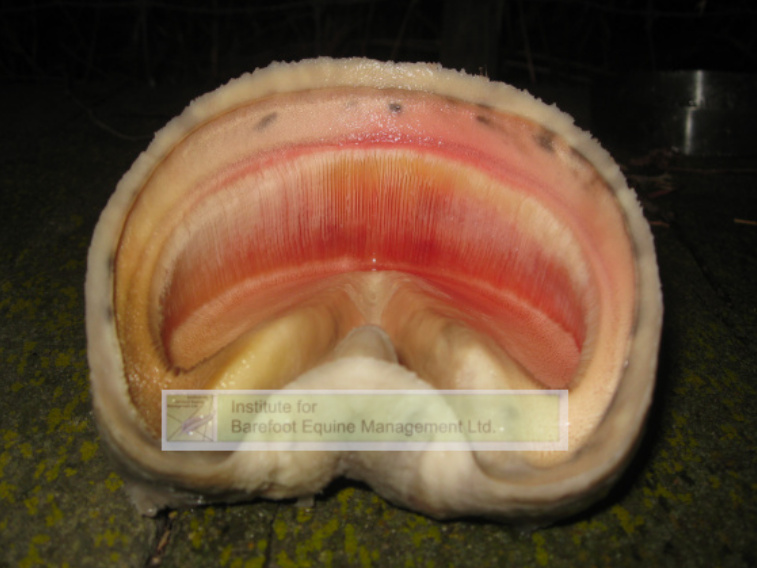
Due to the “letting go” of the laminar connection, if one was to dissect hooves from this scenario, one could expect that the HC pulls away from the laminar corium relatively easily.
Sloughed-off, fairly healthy, Hoofcapsule showing smooth and harmonic lamellae arrangement.
The mechanical overload is by far more common in real life. Typically this starts in the back half of the hoof where discomfort is allowed to develop in the hoof. This can start as early as a few months after birth. The horse shifts weight away from that area and transfers it towards the front half of the hoof – 24/7. This paves the way for chronic overstressing and eventually stretching of the laminar connection, and sometimes even the laminar corium. Those horses commonly present symptoms like fast growing heels, steep pastern alignment, short stride, toe-first landing, possibly stumbles easily, tight muscles around the shoulders. Eventually we see flare in the toes and radiographically we would see P3 and the inner hoofwall are no longer parallel. That means the laminar connection is getting widened. All the while the horse does not show any signs of acute laminitis, but it would most likely be diagnosed with “signs of chronic laminitis”.
The space between P3 and the hoof-capsule is filled out with more laminar horn, often referred to as “laminar wedge”. More laminar horn over a wider space does not make the hoof stronger, but rather the opposite occurs. Usually the harmonic laminar arrangement is disturbed, making the lamellae look rugged and “ripped”. Nevertheless, when dissecting such a hoof, it is typically very hard to separate the laminar horn from its corium – often the corium rips off the bone instead.
Hoof with Laminar Wedge. However, also note the severe deformation in the back half of the hoof.
Typically, a trigger event of some sort (trauma, dietary disturbance, change of ground conditions, change of hoof hydration) occurs, and promotes and acute laminitis. Many horses only get x-rayed at this point, which then shows separation on a hoof with acute laminitis. A very common reason, why it is believed that the laminitis caused the separation.
The problem now is that we are trying to explain, and treat, this second scenario with the reasoning from the first scenario. However, it is to note that a hoof with mechanical distortion and toe overload will have a much lower trigger threshold to chemical overload. The long-term solution then is to lift that trigger threshold and focus on reducing the HC distortion.
A hoof of a 4-months old filly, already demonstrating significant HC distortion with symptoms of toe-overload and bottom-up separation in the dorsal hoofwall (left). On the right, the same hoof much improved.
Horse lame – Vet diagnosis: no signs of laminitis, but since the horse is lame and slightly overweight, it has to be laminitis.
This just happened to a client, and you can imagine how freaked-out the owner was. Unfortunately, it is not a single occurrence to get a laminitis diagnosis, when there is no laminitis.
The horse transitions well to barefoot trimming, is moving freer, muscle tension is going away, stance, loading, and movement patterns are improving. Suddenly, the horse presents with some temporary, often sudden, lameness. Emotions run high, the stressed client calls in a vet for lameness diagnostics. The vet assesses the hoof of concern as it presents, typically without further investigating how the hoof may have changed over the last few months, or how the whole horse has changed over the same period, aka hoof history.
X-rays get taken. No signs of laminitis. Sole thickness good. Bone alignment good. No response to hoof testers. Pulse, not reported on. Conclusion: it must be some low-grade laminitis since the horse is lame and slightly overweight. Restrict High Carb feeds and administer Bute.
Did the hooves show Hoof Mechanism (HM) on loading? Not checked.
A horse with laminitis is typically highly sensitive to hoof rasping. Well, this one wasn’t. No strong or elevated pulse. Happy to lift the hooves for trimming. But overall the hooves were too long and had full bars, due to being ridden less for the previous month, ground being softer, and left and extra week between trims. HM reduced to non-existent. Trim the hooves, get HM established, check for good loading pattern. Within a week the horse is fine again.
Learning to see how your horse loads its hooves and whether or not they have HM is so important. Many problems can be eliminated/prevented by just managing this.
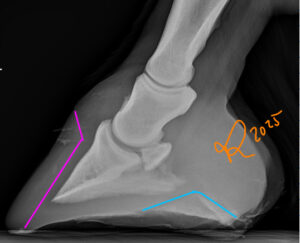
The photo below shows how the inner hoofwall run parallel to the dorsal aspect of P3 (pink line). The blue contour shows the (still) deep Collateral Groove, which can easily lock up when the bar gets too long. The focus needs to be to further relax that region.
Other examples include where horses are lame and have a strong pulse. Diagnosis: Laminitis. Despite the horse standing on the hoof’s toe and unloading the heels. A few days later, a heel abscess opened up.
Don’t be afraid to get another opinion, when your horse gets a laminitis diagnosis.
Laminitis in the making! Imagine, winter is just around the corner, or you maybe you are already in the midst of it. For many horse owners that triggers a sigh of relief – the grass growth is slowing down or is non existent, and the risk of their horse suffering from laminitis is going down for the next few months. Until spring arrives, that is, when the grass starts growing again. Then the laminitis monster will keep those horse owners living in fear, once again.
Unfortunately, the reality is that it is how the horse is kept from now until spring, that significantly influences the odds whether or not the horse will suffer from laminitis this spring.
Let me explain.
For laminar corium to remain healthy, it needs to be regularly and sufficiently stimulated. This occurs when the horse loads and unloads the hoof, on ground that is sufficiently firm to provide the Ground Reaction Force (GRF) to expand the hoof-capsule on loading. In New Zealand, over the summer months, the ground is generally firmer than in winter, and the horses tend to get ridden more. Come winter, the ground gets softer and less riding occurs.
The GRF from the softer ground reduces, and in some instances it maybe insufficient to expand the hoof-capsule properly, thus the laminar corium becomes under-stimulated. This has a negative impact on the laminar horn production, as well as the tissue health itself. Less riding tends to lead to less movement, aka fewer steps, which in conjunction with the previous point amplifies the problem.
Horses often get trimmed at longer intervals in winter, commonly this is due to the hoof not growing as much as in summer. Ironically this is a very clear indicator that the hoof is under-stimulated, the side-effect of under-stimulation is reduced horn production. Hooves with good stimulation in winter, grow horn at the same rate as in summer, often with less abrasion, leading to a greater build up of horn.
Longer trimming intervals can lead to hooves that become too long, which in turn further reduces the hoof’s ability to function properly.
Soft ground allows the hoof to sink in lower in the toe, especially seen frequently in the front hooves. This rotation of the hoof allows for weight transfer towards the laminar connection in the toe region. The result, chronic stress on this connection. Over time, the various living tissues in the hoof, including laminar corium, can become unhealthy tissue.
Other common signs that suggest under-stimulated hooves are, hooves that are cold to touch, frogs that “shrivel up”, thrush, seedy toe or white-line disease, and mudfever just above the hoof region.
Typically, the horse enters winter with a better hoof than they leave it. This means, the symptoms of under-stimulation are not visible for a while, while the better horn grows out. Only at a later state, when the damaging factors have been present for weeks and months, will we see their impact.
Then spring comes around. It gets warmer, the sunshine hours go up, the ground becomes firmer again creating to a higher GRF. As a result, the hooves and their internal living tissues receive more stimulation again, leading to better hoof expansion and blood flow. When unhealthy tissue becomes recognised by the immune system, a healing response kicks in. The response we see when tissue heals, we call inflammation, and the inflammation of laminar corium we call laminitis.
You can see, this mechanism leading to laminitis is independent of grass growth, even though that also occurs at spring time, it is a correlation, not a causation. Therefore, now is the time to take action. Ensure your horse’s hooves are sufficiently stimulated, functioning, and comfortable, and avoid laminitis this spring.
Often the question gets asked, at what age should you start trimming a horse’s hooves? The answer to this is not a fixed point in time, but rather depends on a number of factors and is most likely different for different horses. Ground, amount of movement, breed, hoof shape at birth, etc. all play an important role in this.
As a general rule of thumb, when the hooves start to deviate from the ideal growth and wear pattern, then it is time to intervene. Ideally that means increasing movement to promote growth stimulation and wear. However, typically that is difficult to achieve with a domestic horse, and trimming is required.
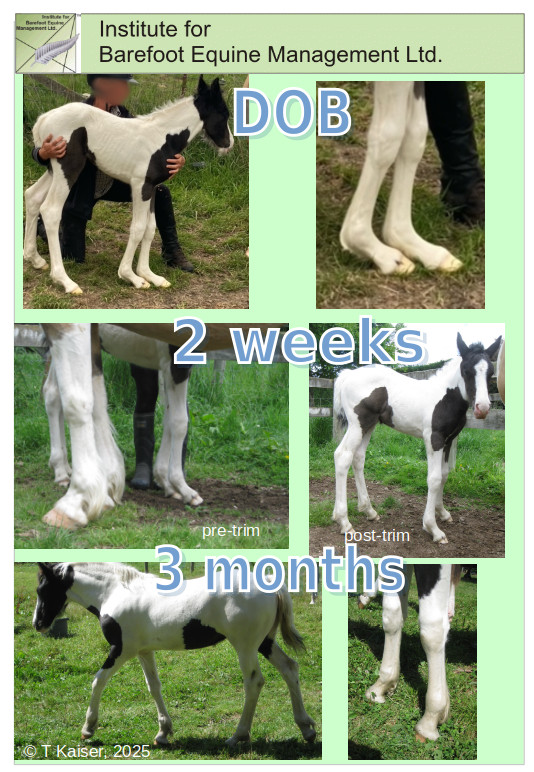
In the example pictured, this foal was born with long sloping pasterns in the front limbs. The hooves presented with Negative Palmar Angle. I advised on what to focus on, and the client started making those adjustments on the day the foal was born. This was supported by appropriate movement stimuli. 2 weeks later, I saw the filly and trimmed the hooves. Note how the pre-tim stance is already better than at DOB, and the post-trim stance is better still. The owner carried on with the trimming adjustments and 3 months later, you wouldn’t know there was a problem.
Ever since I started the barefoot journey, some 20 years ago, there have been some hot debates on how to best address laminitis. Most recently, there has been a flare up on Social Media.
The focus typically is on the Palmar Angle (PA) of the pedal bone (P3). Some argue that lowering the PA is preferable to address laminitis, while others find they have good results by increasing the PA. Typically, the PA-increase group would achieve this by applying wedges to the hoof and then hold it in place with a shoe of some sort. Commonly, the PA-decrease group follows a barefoot approach. Obviously, this can be very confusing as the actions appear to contradict each other.
Adding to the confusion is that there are cases where horses have laminitis despite a low PA, and vice versa, horses have laminitis with a high PA. This would suggest that PA alone is not the key to success here.
There is also confusing use of terminology around the topics of laminitis and founder, but it is probably best to explore this in another article. Commonly when the term laminitis is used, it refers to the separation/gap between the hoofwall and P3 in the toe region. For simplicity reason, let’s just continue to use the term laminitis in that way.
Linked to the PA discussion is the alignment of the pastern bones, aka long pastern (P1), short pastern (P2), and P3. Efforts are then made to trim or wedge the hoof so that the three pastern bones form a straight alignment. You can imagine that a steeper pastern alignment would lead to a higher PA, a less steep alignment to a lower PA.
What often seems to get forgotten in these discussions, and scientific papers are no exception here, is that we are dealing with a living biological system – the horse. Such system has a nervous system and part of that are receptors and nerve endings, that send messages to the brain, to which the horse then can react upon.
Now, imagine the horse has some form of discomfort in the back half of the hoof. Some examples for this can be underrun heels, deep collateral grooves, long bars, etc.. As a response, the horse, most likely, will choose to actively unload the back half of that hoof. It can do this by raising the fetlock joint, which steepens the pastern alignment via muscle action. This is very common to see on front limbs, and the horse tends to place the hooves further back (standing under), which helps with unloading the rear half of the hoof.
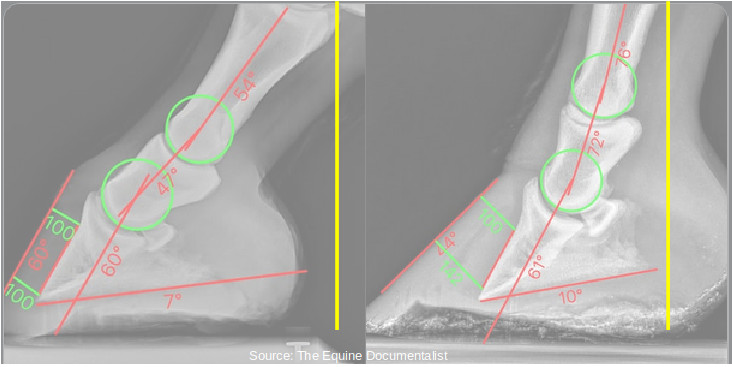
These two images illustrate the issue at hand. Both images show a positive PA, the left without laminitis, the right with laminitis. I have overlaid a yellow vertical line from the back of P1 at the fetlock joint on both images. The image on the left, good loading, has that line run behind the hoof capsule. On the right, active unloading of the heel, that line runs through the hoof capsule.
It is this active, let’s call it unloading of the heel, that in turn leads to an overloading of the front region of the hoof, the toe. Sooner or later, this loading pattern tends to lead to a problem in the font half of the hoof – often laminitis. It is not unusual for this mechanism to be in place for several years, before it gets noticed as laminitis.
With that information in mind, it is easier to understand why some horses get laminitis and other don’t, and how it is not necessarily dependent on the PA of P3. You can have a low PA and good loading, chances are no laminitis will develop. A low PA with active unloading of the heel, however, more than likely will cause problems. Same for a higher PA with good loading, typically no laminitis sets in, high PA and active unloading of the heel, expect laminitis.
We can see the common denominator here is not the PA, but rather the active unloading of the heel. Consequently, in order to heal the hoof, firstly, the reason for this compensation stance needs to be identified and addressed. If the hoofcare practitioner is able to address this and get the horse to stop/reduce actively unloading the heels, then the hoof stands a chance reconnect the hoofwall with P3.
The next time you see a horse, have a look at its loading pattern and stance, then compare it to what is described above. You may start seeing a chronic pattern of horses standing under, actively unloading the heel. They are, unfortunately, ticking time bombs waiting for their trigger.
I have covered this topic in a previous post, so this post is adding another example of what difference appropriate hoofcare can make.
The horse shown on the left is 20yo and has been “barefoot” trimmed for years. I have put the word barefoot in quotes to make a point about the difference between no shoes and non-functioning-hoof-style “barefoot”, which I refer to as un-shod, and barefoot that focuses and leads to functioning and comfortable hooves and horse. The latter is what is taught in our courses.
On the right, the same horse 15 months later, with me working on his hooves. Note how much more relaxed the shoulder and whole body has become. Overall, the horse looks a lot less hunched up and the owner reports the horse is very forward going when being ridden.
Before I started on this horse, he was grass-restricted to nearly no grass and kept in smaller paddocks. He now has more grass access and the ability to move more.
While this post is highlighting the stance difference, have a brief look at the hooves. You can notice how the front hooves are less upright now, while the hind hooves are no longer tilted backward, aka no longer have a negative plantar angle.
Many young horses, unfortunately, do not receive the hoofcare they need and deserve. Typically, hoofcare starts “late”, as in the horse may already be a yearling or later, and is only done sporadically.
The reasons can be manifold:
the foal has not been handled enough to actually get its hooves done.
it’s not doing any work, so it doesn’t need its hooves done
what could possibly be wrong? It’s a young horse!
The profit margin in breeding, for many horses, is not that great, so any extra cost is being minimised.
the horse is not lame, so it doesn’t need hoof trimming
let “nature” take care of it
too many foals on the place and it becomes a time issue to get around to do the hooves regularly enough
and so on
The problem with this is, that typically in most domestic environments, the stimuli that promote a poor hoof are greater than those that promote a good hoof. Consequently, the hoof heads in the wrong direction. When the time comes that the horse is supposed to get started under saddle, its hooves struggle to withstand the sudden demand.
It really should go without saying that any biological system needs to adapt to its stresses placed upon it. A young horse to be started under saddle, should be on a programme that gradually increases the workload, prior to being sent to the person starting the horse. This allows the musco-skeletal system to respond accordingly, including the hooves and their connection to the pedal bone.
Sadly, this is often not the reality and the workload is typically increased from 0-100 in a matter of days. The developing and growing horse then may struggle physically with the new demands placed on it, and often, so do the hooves. The common demand, the horse needs to get shoes put on, so it can do the work it is being asked to do.
The person understanding such biological processes, however, implements a developing programme to get the system (horse) sufficiently prepared to be able to safely meet the demands that are place on it.
As far as hoofcare is concerned, this means trimming should start as soon as there are signs that the hooves develop in the wrong direction. Trimming should be sufficiently frequent, so the hooves can develop to a strong and robust hoof.
What if you have a 4-yo that is to be started, that already has hoof problems? This a common reality. A person may have bought a young horse that already has developed hoof problems as a result of the points raised above. In this case, the priority should be to start developing more robust hooves with better integrity as soon as possible. After-all, the hooves are the foundation for anything else to follow. As part of the hoof development, the movement quantity and intensity should gradually be increased. While this helps with the hoof development, it also helps with the development of the rest of the horse, aka connective tissue, bone density, lung and cardio-vascular capacity. Depending on the starting point, it may take a good year before the horse has some good strong hooves. At this point, given the fore mentioned underlying development programme was implemented, your horse should be ready to be started under saddle.
See the examples below:
Front hoof. Left shows severe coronet distortion and wall flares with a toe crack. On the right with much relaxed coronet and flare grown out, leading to a strong laminar connection. started as 4yo
This 4-yo has significant coronet distortion, see curved coronet line in the photo on the left. From there you can see how the hoof wall at the side of the hoof tries to grow down straight and then is pushed outward. This type of deformation is referred to as flare. A flared hoof wall no longer maintains a tight laminar connection to the internal structures, but rather is a sign of white line problems and poor integrity of the hoof. Those white line problems may or may not be visible at sole level, depending on how the sole horn is distorted. In other words, it is entirely possible to have white line stretching in the hoof that is hidden by a flared sole covering it up. The circle indicates a bottom-up toe-quarter crack at the exact point where the coronet is pushed upwards. The excess tension in the hoof wall, the result of the hoof deformation, causes the horn tubules to separate from each other at the highest stress point and we see it as a crack.
On the right, 18 months later, the hoof wall is a lot more relaxed and the flare has grown out. The horse now has a hoof with much better integrity, aka connection of hoof wall and pedal bone. From a hoof’s point of view, this horse is now ready to be started under saddle.
This 4-yo below (see images on the right), has had “barefoot” hoofcare, but, sadly has very distorted hoof capsules. This horse struggled to stand still on his front hooves when asked to stand on a single front hoof as is needed for trimming. Its gait was “toe heavy” as the horse tried to unload its uncomfortable back half of the hoof.
Again, we see the typical distortion of the coronet (curved upwards) and wall horn tubules that are converging to the toe. The hooves are longitudinally contracted. The collateral grooves of this horse were at least twice as deep as they should be.
Compared to the previous example that showed poor integrity and flare, this one is the opposite and is a very contracted and “tight” hoof.
Severely contracted front hooves on the right. Curved coronet and wall horn tubules compressed forward. Very deep collateral grooves, horse couldn’t stand still on those hooves. On the left much more relaxed hooves. Due to the severity, this horse took longer. started as 4yo
The images on the left, just over 4 years apart, show a much more relaxed hoof capsule with wall horn tubules that run more parallel to each other. Until this point the regrowth between trims has been disproportional in the mid part of the hoof, which affected its function and ability to further de-contract. Considering the relative young age of this horses, this has been a considerable time frame due to a complex hoof problem and not the most optimal supportive boarding situation.
Even foals at the age of 4 months can show significant hoof deformations. Ideally, they get addressed much sooner than that. Basically, when you notice the hooves heading in the wrong direction, then it is time to work on the hooves. When caught early, the trimming needed is usually quite small, since the internal structures are not yet deformed. By the time the foals is 4 months old, however, the internal structures can already be deformed as well, and it takes a bigger effort to correct the hooves again.
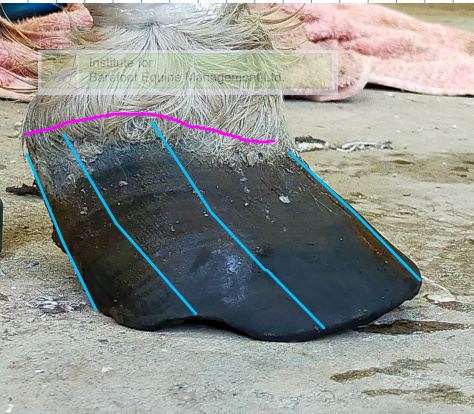
The hoof below clearly shows the first regrowth from when the foal was born. Due to lack of movement, ground stimulation, and wear, the regrowth is very deformed and longitudinally contracted. This is a typical scenario that leads to underrun heels with quarter flares initially, and eventually toe flares.
4-months old foals. The lower pink growth ring marks the end of the foal hoof. The current coronet has the same deformed contour. The blue lines show just how contracted the hoof is growing in.
The hoof of the 4-months old below is setup to become a club foot. Already, the heels are long and the hoof is upright with a short “stubby” toe. Additionally, the foal has already started the grazing pattern with this hoof placed back and the other front hoof out front with most of the weight. Once this habit is for formed, it gets harder and harder to break it, so longer it is present. The hoof at 15 months later shows a less distorted hoofcapsule and the horse is no longer grazing with this foot back all the time. The formation of a club foot could be prevented.
A club foot in the making at 4 months old on the left. Curved coronet and distorted wall horn tubules, with long heels creating an upright hoof. A much more relaxed situation on the right, 15 months later.
Hooves are a very adaptable system to external influences. Unfortunately, in many domestic situations, those external influences are not necessarily helping the hoof development, and ultimately the horse. When more negative influences/stimuli are present than positive ones, the hooves regress. Unfortunately, this may also include how the hoof is trimmed.
On the flip side, given the right stimuli, and enough of it, hooves can change for the better, even at a later stage in life. The limiting factor, however, are the state of the pedal bone, cartilage distortion, and just how much pathology is present and how long it has been present for.
Left: Hind Hoof with slight negative PA, curved coronet and underrun wall horn tubules. Right: coronet much straighter, horn tubules nearly parallel, no negative PA angle. started when 19yo.
Above the hind hoof of a 19-yo that has been “barefoot-trimmed” for years. The left image is taken at the start when I took on the horse, the image on the right, one year late. Both images were taken four weeks post the previous trim.
The contour of the hoof on the left is a common sight. Looking at its coronet, we notice how curved and how steep it is. The steepness indicates a negative plantar angle, which has a negative effect on ligament and tendon strain, as well as timing of break-over.
The curved coronet is the result of excessive wall loading and longitudinal contraction. If a hoof bears too much weight on the outer rim, aka hoof wall, rather than distributing it across the whole bottom structure (at full load), then the coronet usually ends up with this upward distortion in the mid-section of the hoof. While some argue this is merely cosmetic, a cross-section of such hoof reveals that the underlying coronary corium is actually compressed.
This is similar to a human’s cuticle being pushed upwards. The other response to the upwards distortion of the coronet is the longitudinal contraction of the hoof. When you look at the blue line marking the wall horn tubule at the toe and then compare that to the horn tubules of the side, you can see how the converge towards each other. This means that the back of the hoof has rotated forward in relation to its toe. The result of this is that there is less space in side the hoof capsule, especially in the back half of the hoof, where we find the digital cushion in the navicular region. Typically, this leads to compromised comfort and the horse tends to compensate for that.
On the right, the hoof is in a much more “relaxed” state. The coronet has straightened out and the wall horn tubules are running nearly parallel to each other. A little bit more to do here to achieve a parallel alignment. The hoof has lengthened in the back half and can happily load the heels without the need to compensate.
The horse is now happily striding out and willing to go forward.